

West Contra Costa Transportation Commission
Richmond Parkway Transit Plan — Appendix E: Funding sources
Where the money for the concept could come from.
Appendix · Final · 2025 · 1 figures · about 12 min to read
Where the money for the concept could come from.
Current — In force. This is the version to rely on. The adopted final version.
Appendix E:
Existing Funding Sources for
Priority Strategies
Appendix E: Existing Funding Sources for Priority Strategies |
Program Funding Source Acronym WB-1 WB-2 DG-1 S-1 S-2 M-1 PH-1 PH-2 PH-3 T-1 Administering Agency Type Administering Agency Programming Authority Strengthening Mobility and Revolutionizing Transportation Grants SMART Federal Office of Secretary USDOT Infrastructure Investment and Jobs Act (IIJA) RAISE Grant RAISE Federal Office of Secretary USDOT U.S. Department of Transportation Active Transportation Program ATP State Caltrans Senate Bill 99, California Assembly Bill 101 Urban Greening Grant State CA Natural Resources Agency Cap and Trade Clean Transportation Incentives (various programs including Electric Bicycle Incentives Project) State CARB California Air Resources Board Transformative Climate Communities TCC State Strategic Growth Council and CA Department of Conservation Greenhouse Gas Reduction Fund (GGRF)
Original PDF, page 3
Eligible Applicants Purpose and Eligibility Website Maximum Amount Available State, Cities, Counties, MPO, public transit agency/authority, public toll authority Demonstration Projects Utilizing Innovative Technology to Improve Transportation Efficiency and Safety. In general, a Strengthening Mobility and Revolutionizing Transportation grant may be used to carry out a project that demonstrates at least one of the following: Coordinate Automation Connected Vehicles; Intelligent, sensor-based infrastructure; Systems integration; Commerce delivery and logistics; Leveraging use of innovative aviation technology; Smart grid; Smart technology traffic signals.
https://www.whitehouse.gov/wp- content/uploads/2022/05/BUILDI NG-A-BETTER-AMERICA- V2.pdf#page=65 https://www.transportation.gov/si tes/dot.gov/files/2024- 05/SMART%20FY24%20Stage%20 Max award for each stage are - Stage 1: $2M; Stage 2: $15M Cities, Counties, transit operators, public agency, special district or public authority with a transportation function or multijurisdictional group of entities that are separately eligible Road, rail, transit and port projects that promise to achieve national objectives. Projects should leverage development and help to build and repair critical pieces of our freight and passenger transportation networks. Eligible projects for RAISE grants are:
Relevant capital projects include but are not limited to: highway, bridge, or other road projects; public transportation projects; passenger and freight rail transportation projects;
port infrastructure investments; intermodal projects; and any other surface transportation infrastructure project that the Secretary considers to be necessary to advance the goals of the program.
Planning projects which include planning, preparation, or design (for example - environmental analysis, equity analysis, community engagement, feasibility studies, benefit cost analysis (BCA), and other pre-construction activities) of eligible surface transportation capital projects that will not result in construction with RAISE FY 2024 f https://www.transportation.gov/R AISEgrants https://www.transportation.gov/si tes/dot.gov/files/2024- 02/FY%202024%20RAISE%20NOF O%20Amendment%201.pdf Max award for capital and planning grants:
$25M Local, regional, or state agencies, Caltrans, Transit Agencies, Natural Resources or Public Land Agencies, schools, tribal governments, nonprofits, any other entity with oversight of transportation/recreational trails Funds safe routes to to school, pedestrian, bicycle, and trail projects. Disadvantaged communities must receive at least 25 percent of the program's funding. California Transportation Commission oversees guidelines and programming.
https://dot.ca.gov/programs/local- assistance/fed-and-state- programs/active-transportation- program Total Funding Available in Cycle 7 = $568M made up of Federal, State SB1, and State Highway Account (SHA) funding No specific maximum amount provided.
Minimum request is $250,000. The Program anticipates application for Large projects with total project cost of greater than $10M, Medium projects between $3.5M to $10M, etc.
City, county, special district, nonprofit org, or agency/entity formed pursuant to the Joint Exercise of Powers Act The Program supports the development of green infrastructure projects that reduce GHG emissions and provide multiple benefits. Must include at least one of the following:
- Sequester and store carbon by planting trees
- Reduce building energy use by strategically planting trees to shade buildings
- Reduce commute vehicle miles traveled by constructing bicycle paths, bicycle lanes or pedestrian facilities that provide safe routes for travel between residences, workplaces, commercial centers, and schools.
Gives priority to, projects that are located within and benefit the State’s disadvantaged communities and those communities facing the most significant threat from extreme heat.
https://resources.ca.gov/grants/ur ban-greening/ No max or min grant amounts. 80% of awarded funds to disadvantaged and low income communities (AB 1550) Approx. $47.5M available in 2021.
varies by program; but previous investments suggest largely state agencies Annual budget appropriation guided by the priorities in the Cap and Trade Auction Proceeds Investment Plan
- Facilitate greenhouse gas reductions
- Benefit priority populations
- Maximize health, environmental, economic co-benefits
- Continue investments in existing programs
- Provide funding certainty over multiple years when possible
- Support job training and apprenticeship opportunities https://ww2.arb.ca.gov/our- work/programs/low-carbon- transportation-investments-and- air-quality-improvement- program/low-1
Varies by program CBOs, local governments, nonprofit orgs, philanthropic orgs/foundations, faith-based orgs, coalitions or associations of nonprofits, community dev finance institutions, community dev corporations, joint powers authority, CA native american tribes The Program funds community-led development and infrastructure projects that achieve major environmental, health, and economic benefits in California’s most disadvantaged communities. (California Climate Investments) Eligible Types:
- Bicycle and pedestrian facilities
- Bike share programs (However must be part of a larger placebased strategy) http://www.sgc.ca.gov/programs/ tcc/
Based on Round 5 TCC Program included 3 grant types: 1) implementation grants could be requested for up to $29.5M, 2) project development grants could be requested up to $5M, and 3) planning grants could be requested up to $300,000.
Appendix E: Existing Funding Sources for Priority Strategies |
Original PDF, page 4
Program Funding Source Acronym WB-1 WB-2 DG-1 S-1 S-2 M-1 PH-1 PH-2 PH-3 T-1 Administering Agency Type Administering Agency Programming Authority Sustainable Transportation Equity Project STEP State CARB Greenhouse Gas Reduction Fund (GGRF) Highway Safety Improvement Program HSIP State Caltrans Local Assistance Caltrans Low Carbon Transit Operations Program (LCTOP) LCTOP State Caltrans Greenhouse Gas Reduction Fund (GGRF) Local Partnership Program (LPP) Formula & Competitive Programs LPP State CTC State Senate Bill 1 One Bay Area Grant Program - Regional and County OBAG 3 Regional MTC, CCTA Federal Highway Administration Transportation Development Act Article 3 TDA 3 Regional MTC, Contra Costa County Transportation Development Act (TDA) Regional Transportation Improvement Program RTIP Regional MTC, CCTA State Transportation Improvement Program (STIP) Transportation Fund for Clean Air TFCA Regional BAAQMD, CCTA BAAQMD Clean Air Plan
Original PDF, page 5
Eligible Applicants Purpose and Eligibility Website Maximum Amount Available Lead applicants: CBO, tribal governments, local governments, school Sub applicants: CBOs, consultants, higher education institutions, joint powers authorities, local governments, non-profits, philanthropic orgs/foundations, private companies, schools, small businesses transit agencies, tribal govs, utilities and community choice aggregators, other public agencies Planning and capacity building grants. Funding is intended to help low-income and disadvantaged communities identify residents’ transportation needs and prepare to implement clean transportation and land use projects. The Program makes $20 million available for 1-3 implementation block grants to fund clean transportation and land use projects in disadvantaged communities. Funded projects will work together to increase community residents’ access to key destinations so they can get where they need to go without the use of a personal vehicle.
Eligible Types:
- Bike or pedestrian facilities
- Active Transportation Plan
- Safe Routes to School Plan
- Capacity Building (NI Programs– education, engagement, demo projects, campaigns)
- Publicly-accessible bike parking, storage, and repair infrastructure (e.g., bike racks, bike lockers, bike repair kiosks)
- New walkways that improve mobility/access/safety of pedestrians (non-motorized users)
- Street crossing enhancements, including accessible pedestrian signals https://ww2.arb.ca.gov/lcti-step
Max available for each grant type - Planning and Capacity Building grant max: $750,000 CMIS and STEP grant: $15M local public agency that owns, operates and maintains public roadways in CA, includes city, county or tribal government The Program funds work on any public road or publicly owned bicycle or pedestrian pathway or trail, or on tribal lands for general use of tribal members, that improves the safety for its users. Project maximum funding- $10M. Solicitation varies from annually to semi-annually Eligible Types:
- Safety projects on Bike facilities
- Safety projects on Ped facilities https://dot.ca.gov/programs/local- assistance/fed-and-state- programs/highway-safety- improvement-program https://dot.ca.gov/-/media/dot- media/programs/local- assistance/documents/lapg/g09.p
Max amount an agency can review varies by calls-for-projects, but Cycle 12 max is $10M. transit operators and transportation planning agencies Operating and capital assistance for transit agencies to reduce GHG emissions and improve mobility with a priority on serving disadvantaged communities; new or expanded intermodal transit facilities; operational expenditures that increase transit mode share.
http://www.dot.ca.gov/drmt/splct op.html Varies depending on auction proceeds CCTA, Cities (Jurisdictions with voter approved taxes, tolls, or fees, which are dedicated solely to transportation improvements or that have imposed fees, including uniform developer fees, which are dedicated solely to transportation improvements.)
Improvements to state highways, transit facilities and local roads; acquisition, retrofit or rehab of rolling stock, buses or other transit equipment including facilities; improvements to bicycle and pedestrian safety; environmental mitigation projects, soundwalls, road maintenance, and rehabilitation projects.
The primary objective of this program is to provide funding to counties, cities, districts, and regional transportation agencies in which voters have approved fees or taxes dedicated solely to transportation improvements or that have imposed fees, including uniform developer fees, dedicated solely to transportation improvements. Improve aging Infrastructure, Road Conditions, Active Transportation, Transit and rail, Health and Safety Benefits.
https://catc.ca.gov/programs/sb1/ local-partnership-program Competitive Program funding request has maximum of $25M per project nomination. The 2022 Local Partnership Program will include two years of programming with $400 million in funds ($40 million formulaic incentive funding set aside; $216 million via Formulaic; and $144 million via Competitive) covering Fiscal Years 2023-24 and 2024-25.
cities, counties, transit agencies, federally-recognized Tribal governments, and CTAs Maintain MTC's commitments to regional transportation priorities while also advancing the Bay Area's land-use and housing goals. Contra Costa County is focusing efforts on around encouraging active transportation like bicycling and walking, supporting safe routes to schools, implementing complete streets, and upgrading the countywide traffic signal system to "smarter" signals that can prioritize transit and emergency vehicles and hlep improve safety for people walking/biking at intersections.
https://mtc.ca.gov/funding/federa l-funding/federal-highway- administration-grants/one-bay- area-grant-obag-3 https://ccta.net/planning/one-bay- area-grant-3/ https://mtc.ca.gov/sites/default/fi les/documents/2024-05/RES- 4505_approved_0.pdf Total available for Contra Costa County: $47.3 million between 2023-2026 Cities, counties 2% of County TDA funds are set aside for bicycle and pedestrian projects through Article 3.
MTC oversees program. Funding is allocated by formula according to population in each jurisdiction, and jurisdictions may spend funds or roll them over to a future year. Some counties competitively select projects, while other counties distribute the funds to jurisdictions based on population. Each County determines program of projects through review process. Each local jurisdiction receive funds that can roll over to accomplish local priorities.
Amount varies by jurisdiction based on formula transit operators, cities, counties The STIP is the biennial five-year plan adopted by the Commission for future allocations of certain state transportation funds for state highway improvements, intercity rail, and regional highway and transit improvements. Local agencies should work through their Regional Transportation Planning Agency (RTPA), County Transportation Commission, or Metropolitan Planning Organization (MPO), as appropriate, to nominate projects for inclusion in the STIP.
https://mtc.ca.gov/tags/rtip Individual project limit not found. 2025 TIP awarded total of $345M for 49 projects in Contra Costa County. Countywide Smart Signals is one TIP project with a cost of $30M.
Public agencies, CCTA subregions Funds eligible projects that reduce on-road motor vehicle emissions http://www.baaqmd.gov/funding- and-incentives/public- agencies/regional-fund https://www.alamedactc.org/fund ing/fund-sources/transportation- fund-for-clean-air/ For the TFCA 40% Fund Policy, WCCTC is allocated 22.2% of the Program, and CCTA annually distributes $1.5M in total, giving a maximum allocation of $333,000 to WCCTC.
For the remaining 60%, each public agency may be awarded up to total award of $5,500,000 per agency per fiscal year.
Appendix E: Existing Funding Sources for Priority Strategies |
Original PDF, page 6
Program Funding Source Acronym WB-1 WB-2 DG-1 S-1 S-2 M-1 PH-1 PH-2 PH-3 T-1 Administering Agency Type Administering Agency Programming Authority 15a Regional Measure 3 - Safe Routes to Transit and Bay Trail Program RM3 - SR2TBT Regional MTC, BATA RM3 15b Regional Measure 3 - Goods Movement and Mitigation RM3 Regional MTC, ACTC RM3 Regional Measure 3 - Corridor-specific Projects RM3 Regional MTC MTC Innovative Deployments to Enhance Arterials through Transit Signal Priority (IDEA TSP) Regional MTC MTC Measure J Programs Regional CCTA CCTA Promoting Resilient Operations for Transformative, Efficient, and Cost-saving Transportation PROTECT Federal FHWA Infrastructure Investment and Jobs Act (IIJA) Reconnecting Communities Grant Program RCP Federal FHWA Infrastructure Investment and Jobs Act (IIJA) Advanced Transportation Technologies and Innovative Mobility Deployment ATTAIN Federal FHWA Infrastructure Investment and Jobs Act (IIJA) Active Transportation Infrastructure Investment Program ATIIP Federal FHWA Infrastructure Investment and Jobs Act (IIJA)
Original PDF, page 7
Eligible Applicants Purpose and Eligibility Website Maximum Amount Available City, County, transit agencies, school districts, community colleges and universities Improve bicycle and pedestrian access on and near the region’s toll bridges connecting to rail transit stations and ferry terminals. Access improvements include sidewalks, bike paths, traffic signal improvements, clearer signage and secure bicycle parking. The improvements will be funded via an increase in bridge tolls on all Bay Area toll bridges except the Golden Gate Bridge.
https://mtc.ca.gov/funding/reg ional-funding/regional- measure-3 https://planbayarea.org/sites/ default/files/meetings/attachm Per expenditure plan, $150M available for Bay Trail/Safe Routes to Transit over 3 cycles.
City, County, countywide transportation agencies, rail operators, and the Port of Oakland Reduce traffic congestion and improve transportation options throughout the SF Bay Area's state-owned toll bridge corridors. The improvements will be funded via an increase in bridge tolls on all Bay Area toll bridges except the Golden Gate Bridge. Eligible projects include, but are not limited to, improvements in the County of Alameda to enable more goods to be shipped by rail, access improvements on Interstate 580, Interstate 80, and Interstate 880, and improved access to the Port of Oakland.
https://mtc.ca.gov/funding/reg ional-funding/regional- measure-3 https://leginfo.legislature.ca.g ov/faces/codes_displaySection .xhtml?lawCode=SHC§ion Num=30914.7 https://mtc.ca.gov/sites/defaul t/files/documents/2024- 02/__03_04_2024%20Full%20A genda%20Packet%20RM3%20I ndependent%20Oversight%20 Committee_v4.pdf https://mtcdrive.app.box.com/ s/x35lm2ocq0qw147fo7qpxchb vfb59l70 Per expenditure plan, $160M for Goods Movement and Mitigation BATA, CCTA Richmond-San Rafael Bridge Access Improvements. Fund eastbound and westbound improvements in the Richmond-San Rafael Bridge corridor, including westbound access and operational improvements in the vicinity of the toll plaza east of the bridge in Contra Costa County, and Richmond Parkway interchange improvements.
https://mtc.ca.gov/funding/reg ional-funding/regional- measure-3 $75M for projects in Contra Costa County cities, counties, and transit agencies; multi-jurisdictional partnerships will receive priority This Call for Technical Assistance dedicates $2 million to further the project-readiness of conceptual Transit Priority Projects by developing them into shovel-ready projects that would be more competitive for capital implementation funding. MTC’s has over $20 million reserved for near-term capital Transit Priority projects through its BusAID (Bus Accelerated Infrastructure Delivery) and IDEA programs, and anticipates funding opportunities in the future.
https://abag.ca.gov/technical- assistance/idea-tsp-transit-signal- priority#:~:text=The%20Innovativ e%20Deployments%20to%20Enh ance,transit%20faster%20and%2 0more%20reliable.
Maximum award of $1M Contra Costa County Subregions Richmond Parkway is allocated $16 million as one of the Capital Improvement Projects in Measure J's Expenditure Plan. The objective/reason for this allocation is detailed as follows:
Upgrade the Richmond Parkway to facilitate transfer of ownership to the California Department of Transportation, including potential intersection and interchange upgrades, and/or provide funds to maintain the roadway. The Richmond Parkway is the priority project for this funding; however, funds not expended for this project may be reprogrammed at the City of Richmond’s request for Richmond ferry service.
https://ccta.net/about- us/funding/ https://ccta.net/wp- content/uploads/2018/10/5297b1 21d5964.pdf Allocated $16M in total States, MPOs, local governments, special districts or public authorities with a transportation function, tribal governments, and federal land management agencies Formula funding to states to support planning, resilience improvements, community resilience and evacuation routes, and at-risk coastal infrastructure. Includes transit, highways, and certain port projects. Additional competitive funding available.
https://www.whitehouse.gov/wp- content/uploads/2022/05/BUILDI NG-A-BETTER-AMERICA- V2.pdf#page=272 https://www.fhwa.dot.gov/biparti san-infrastructure- law/fact_sheets.cfm No max grant amount but expected distrbution of up to $7.3B total over 2022- 2026.
States, units of local government, Tribal governments, Metropolitan Planning Organizations, and non-profit organizations. The purpose of the RCP Program is to reconnect communities by removing, retrofitting, or mitigating transportation facilities, like highways or rail lines, that create barriers to community connectivity, including to mobility, access, or economic development. The program funds planning and capital construction to address infrastructure barriers, reconnect communities, and improve peoples’ lives.
https://www.transportation.gov/r econnecting $150 million for planning, $457 million for construction in FY24 State Governments; Local Governments; Planning and Project Organizations; Academic and Research Institutions; U.S.
Territories Provides funding to deploy, install, and operate advanced transportation technologies to improve safety, mobility, efficiency, system performance, intermodal connectivity, and infrastructure return on investment.
https://www.transportation.gov/r ural/grant-toolkit/advanced- transportation-technologies-and- innovative-mobility-deployment $12 million State Governments; Local Governments; Federally Recognized Tribes and Affiliated Groups; Planning and Project Organizations; U.S. Territories ATIIP projects will help improve the safety, efficiency, and reliability of active transportation networks and communities; improve connectivity between active transportation modes and public transportation; enhance the resiliency of on- and off-road active transportation infrastructure; help protect the environment; and improve quality of life in disadvantaged communities through the delivery of connected active transportation networks and expanded mobility opportunities.
https://www.transportation.gov/r ural/grant-toolkit/active- transportation-infrastructure- investment-program-atiip $15 million
Appendix E: Existing Funding Sources for Priority Strategies |
Original PDF, page 8
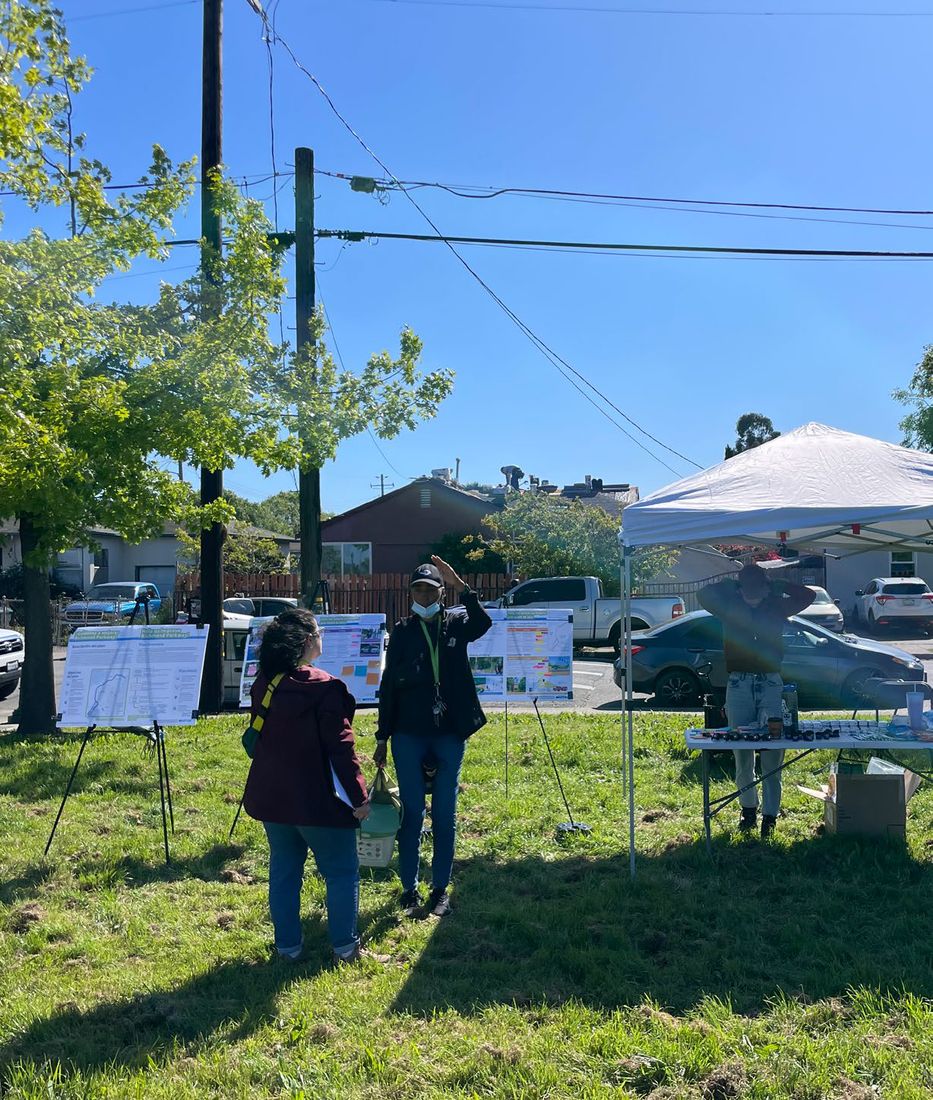
Photo of Earth Day pop-up event during Phase 2 of engagement in North Richmond.
In the same set
The original file
Everything above is the content of the original document, published here as a web page so it can be read, searched, translated and used with a screen reader. The original PDF is kept as the authoritative record.