

West Contra Costa Transportation Commission
STMP administrative guidelines and quarterly report form
How the programme is administered, and what each jurisdiction has to report every quarter. The report itself is now filled in on this site.
Guidelines · 2020 · 2 figures · about 8 min to read
How the programme is administered, and what each jurisdiction has to report every quarter. The report itself is now filled in on this site.
Current — In force. This is the version to rely on.
June 11, 2020
WEST CONTRA COSTA
TRANSPORTATION ADVISORY
COMMITTEE
SUBREGIONAL
TRANSPORTATION
MITIGATION PROGRAM
(STMP) FEE
ADMINISTRATIVE
GUIDELINES
A P P R O V E D B Y WCCTAC E XE C U T I V E
D I R E C T O R J UN E 11, 2020
R E V I E W E D B Y WCCTAC TAC 6/11/2020
West Contra Costa Transportation Advisory Committee STMP Fee Administrative Guidelines Appendix A. Appendix B:
West Contra Costa Transportation Advisory Committee STMP Fee Administrative Guidelines A. INTRODUCTION The purpose of these Administrative Guidelines is to assist WCCTAC and Agency staff with implementation of the STMP Fee. These Guidelines provide additional detail not included in the Master Cooperative Agreement (“Coop Agreement”), and the Coop Agreement is an integral part of these Guidelines. “Agency” or “Agencies” is used in these Guidelines as the term is used in the Master Cooperative Agreement to indicate the cities and the County that are members of WCCTAC and responsible for collecting the STMP Fee and for sponsoring certain capital projects funded by the STMP Fee. The term Agencies excludes AC Transit and the Bay Area Rapid Transit District that are also members of WCCTAC because these agencies have no role in collecting the STMP Fee.
Future modifications to these Guidelines will be reviewed by the WCCTAC Technical Advisory Committee (TAC) before approval by the WCCTAC Executive Director.
B. DEVELOPMENT PROJECTS Agencies shall apply the STMP Fee to building permits associated with all Development Projects as defined in this section, unless exempt under Section D.9 of the Coop Agreement.
1. New Construction Includes construction of new building space for either residential or non-residential use(s), including the addition of building space to existing developed property.
2. Intensification of Use Includes the intensification of use of all or part of an existing building, whether vacant or not. An intensification of use occurs when a Development Project would pay a higher fee under the proposed use compared to the existing permitted use based on the current STMP Fee schedule. All accessory dwelling units are not considered an intensification of use and no STMP Fee would be applied.
In the case of the re-use of a vacant building, the building’s current use shall be the use when the building was occupied if the vacancy had occurred within three years prior to the date of the building permit application. If the vacancy had occurred greater than three years prior to the date of the building permit application, then the STMP Fee shall be applied as if the project was New Construction. The building permit applicant bears the burden of demonstrating that the building was in use within this time period through submittal of documents acceptable to the Agency such as executed lease agreements or lease payment records.
C. LAND USE CATEGORIES The Agency, as part of their typical process of reviewing a proposed Development Project, shall determine the land use categories that are applicable and shall calculate the STMP fee. This applies to both private and public Development Projects. The following sections offer guidance to the Agency as they make those determinations.
Original PDF, page 4
West Contra Costa Transportation Advisory Committee STMP Fee Administrative Guidelines 1. Residential Land Uses i. Single Family Residential: Dwelling units that are one single family detached unit on a parcel, and excluding Senior Housing.
ii. Multi-Family Residential: Dwelling units that are apartments, condominiums, townhomes, multiplexes, or mobile homes in mobile home parks, except Senior Housing. Accessory dwelling units are not required to pay the STMP Fee.
iii. Senior Housing: All senior age-restricted dwelling units regardless of type of housing. 2. Non-residential Land Uses i. Hotel: Temporary lodging establishments including hotels, motels, resorts and bed and breakfast establishments.
ii. Office: Office facilities where the primary use is not direct service to customers, including branch and head offices, multi-tenant buildings, and business parks.
iii. Retail/Service: Neighborhood, community, and thoroughfare commercial districts, including retail and personal service businesses, restaurants, and medical offices.
iv. Industrial: Light and heavy industrial uses, including manufacturing, processing, fabrication, and distribution. v. Storage Facility: Facilities used for the purposes of renting or leasing individual storage space.
3. Other Land Uses i. Other: The Other land use category is intended for Development Projects with land uses that do not fit within the standard residential or non- residential categories defined above where number of dwelling units or building square footage are the usual measures of trip generation. It is anticipated that most Development Projects will fit within the standard STMP categories, but it is understood that some Projects will contain land uses with trip generation characteristics that are not adequately captured by the standard STMP categories. Examples of such land uses could include gas stations, drive-through facilities, private schools, and theaters or other entertainment venues, among others. The Agency will determine whether a particular Development Project involves land uses that should be treated within the Other category; conferral with WCCTAC staff is highly recommended if there are questions or discussion items. Application of the
Original PDF, page 5
West Contra Costa Transportation Advisory Committee STMP Fee Administrative Guidelines Other category will require the estimation of the number of AM peak hour trips that will be generated by the proposed land use.
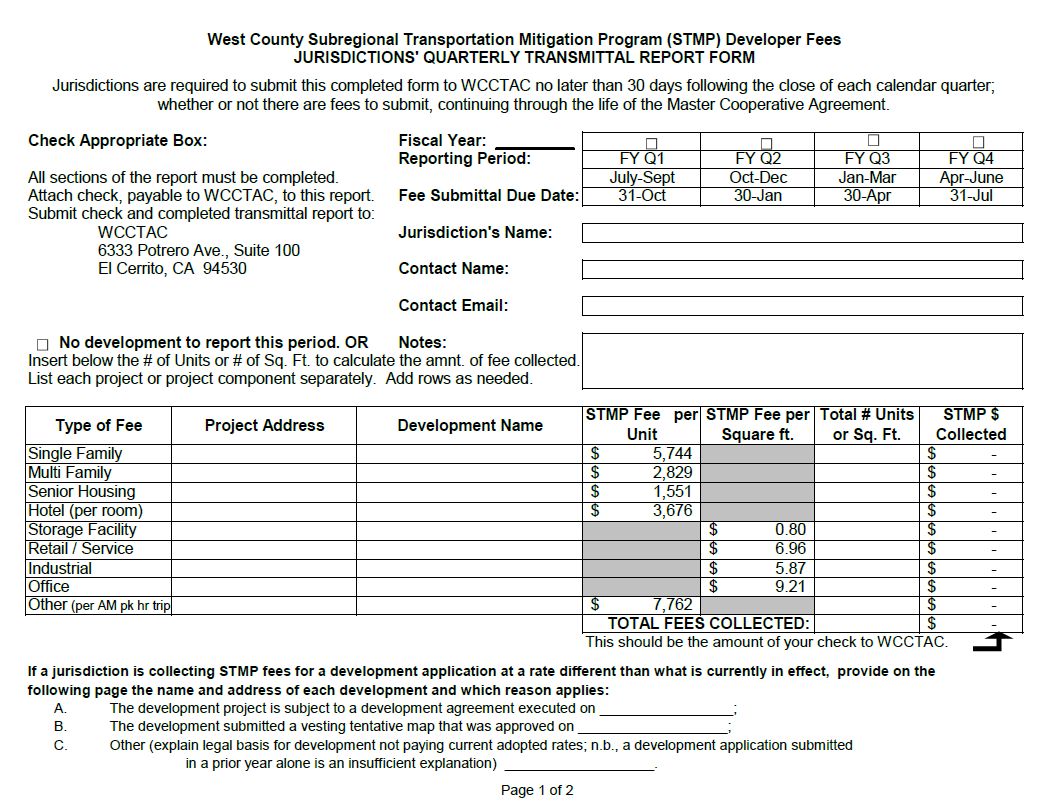
D. FEE CALCULATION 1. New Construction STMP Fee = STMP Fee per Dwelling Unit or per Square Foot Based on Applicable Land Use Category X New Dwelling Units or New Square Feet For Development Projects with multiple land use categories, the STMP Fee equals the sum of STMP Fees applied to each land use category.
2. Intensification of Use First calculate the STMP Fee for the proposed new use, using the formula provided in the section above on New Construction. Then calculate what the STMP Fee would be for the existing permitted use (that is, the existing square footage multiplied by the STMP Fee per square foot for the existing permitted land use category). Subtract the existing permitted use fee from the proposed new use fee.
If the difference is greater than zero, that difference represents the STMP Fee due as a result of the intensification of use. If the difference is less than zero, then no STMP Fee is due, nor will there be any STMP Fee refund or credit.
3. Other Land Use Category STMP Fee = STMP Fee per AM Peak Hour Trip Number of New AM Peak Hour Trips Estimated for Proposed Use As described above, the Agency will determine the applicability of the Other category, as part of its typical process of evaluating the transportation and other impacts of a proposed Development Project. Transportation impact analysis requires the processes and methods outlined in the Technical Procedures adopted by the Contra Costa Transportation Authority.
Part of a transportation impact analysis involves estimating the trip generation of the proposed Development Project. This typically involves reference to the most current edition of Trip Generation published by the Institute of Transportation Engineers (ITE), but may also involve conducting trip generation surveys at other sites that share the Development Project’s characteristics, as further described in the ITE manual and in the Technical Procedures. For reference purposes, see the Appendix for the trip generation rates used in the STMP nexus study for each land use category.
Original PDF, page 6
West Contra Costa Transportation Advisory Committee STMP Fee Administrative Guidelines E. CREDITS AND REIMBURSEMENTS Refer to the approved Master Cooperative Agreement, Section D. Fees, paragraph 10.
Credits and Reimbursements. F. APPEALS FOR FEE EXEMPTIONS AND WAIVERS No exemption or waiver of the STMP Fee for a development project is allowed except as permitted by this section.
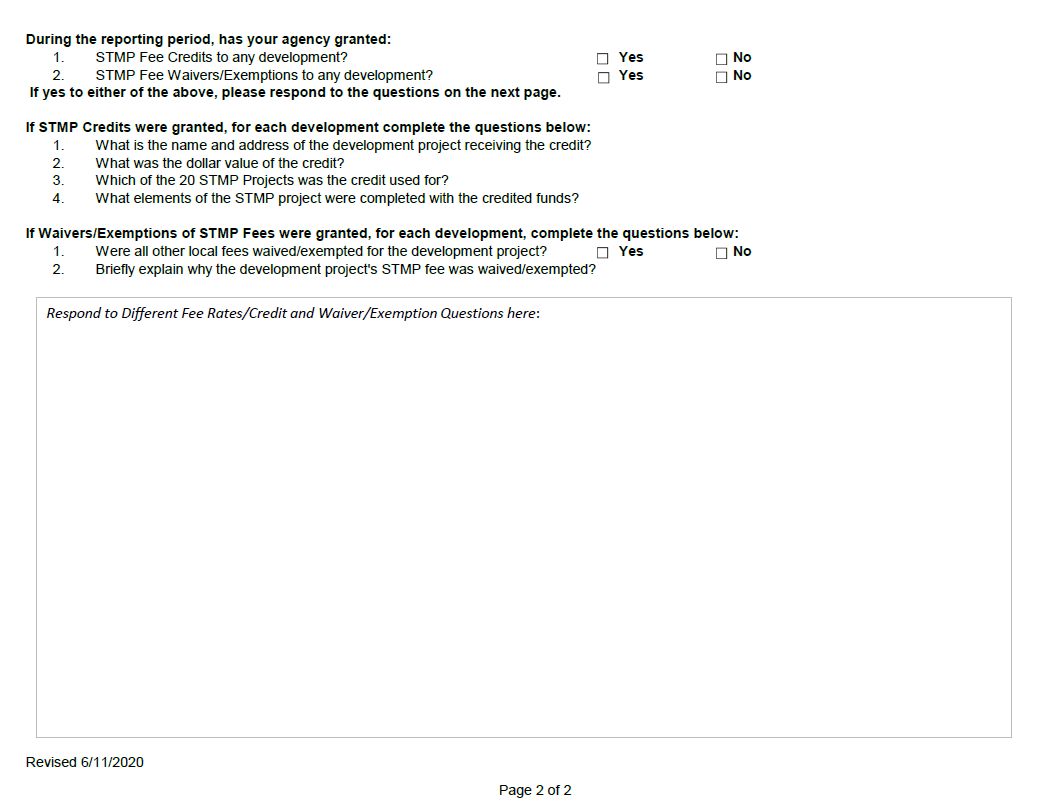
- If the Agency exempts or waives all other local impact fees, then the STMP fee may also be exempted or waived; the Agency must report this action to WCCTAC.
- Otherwise, to be granted a STMP fee exemption or waiver, the Agency or the development project applicant must:
Pay the STMP Fee pursuant to these Administrative Guidelines under protest pending the resolution of the appeal.
Appeal the STMP Fee no later than the date of application for the building permit for the Development Project.
Bear the burden of establishing satisfactory factual proof of the basis for the appeal based on the opinion of a registered traffic engineer.
Submit all information in support of the appeal necessary for WCCTAC’s consideration of the appeal. The Agency or applicant may submit any documentation it thinks WCCTAC should consider as part of the appeal.
Additional issues raised once the appeal is submitted will not be considered by WCCTAC. WCCTAC may require, at the expense of the Project Applicant, review of the submitted materials by a third party with appropriate technical knowledge.
Pay the cost of processing the appeal, as determined by WCCTAC.
The appeal will be considered by the WCCTAC Board within 180 days. The appellant may, at the sole discretion of WCCTAC, have the opportunity to present oral testimony, in addition to the written documents submitted in support of the appeal.
If all other local impact fees are not waived, then any STMP fee exemption or waiver must receive approval from the WCCTAC Board. G. ANNUAL FEE ADJUSTMENT The annual fee adjustment provided for in Section D.8 of the Master Cooperative Agreement is based on the annual percentage change in the Engineering News-Record Construction Cost Index for the San Francisco Bay Area. WCCTAC staff will annually calculate the increase and is responsible for notifying all Agencies of the change bringing the adjusted STMP Fee schedule to a regular meeting of the WCCTAC Board as an
Original PDF, page 7
West Contra Costa Transportation Advisory Committee STMP Fee Administrative Guidelines information item, and providing the adjusted STMP fee schedule to the Agencies in a timely manner each year so that Agencies can begin collecting the updated adjusted fees by July 1.
H. CONCEPTUAL PROCESS FOR STMP FUNDING WCCTAC is responsible for implementing the STMP. Periodically, WCCTAC will issue a call for projects to invite Agencies to submit requests for funding for STMP-eligible projects. Under normal circumstances, a call for projects will occur every 1-3 years, at WCCTAC’s discretion and depending on fund availability.
Evaluation of the projects submitted will be undertaken by WCCTAC staff at the direction of the WCCTAC Board, with input from the WCCTAC TAC. The Board will make the final decisions about which projects will receive STMP funds and in what amounts. Factors to be considered in evaluating projects may include (but not be limited to) characteristics such as project readiness, ability to use funds quickly, amount of funds requested compared to amount available, reasonable distribution of funds across all project categories, and reasonable distribution of funds across all Agencies.
Original PDF, page 8
| Land Use Category | ITE Land Use Code | Unit | A.M. Peak Hour Vehicle Trip Generation Rate |
|---|---|---|---|
| Single-Family Residential | 210 | Dwelling Unit | 0.74 |
| Multi-Family Residential | 221 | Dwelling Unit | 0.36 |
| Senior Housing | 252 | Dwelling Unit | 0.20 |
| Hotel | 310 | Room | 0.47 |
| Retail/Service | 820 | 1,000 Square Feet | 0.94 |
| Office | 710 | 1,000 Square Feet | 1.16 |
| Industrial | 110 | 1,000 Square Feet | 0.70 |
| Storage Facility | 151 | 1,000 Square Feet | 0.10 |
West Contra Costa Transportation Advisory Committee STMP Fee Administrative Guidelines APPENDIX A. A.M. PEAK HOUR TRIP GENERATION RATES A.M. Peak Hour Trip Generation Rates for STMP Land Use Categories Storage Facility 1,000 Square Feet 0.10 Source: Institute of Transportation Engineer, Trip Generation (10th Edition). Note that no trip adjustments have been applied to these trip generation rates; adjustments might be appropriate depending on the characteristics of the Development Project being evaluated.
Original PDF, page 9
West Contra Costa Transportation Advisory Committee STMP Fee Administrative Guidelines APPENDIX B: STMP FEE SUBMITTAL FORM 3136145.1
This one is a form now
The report this document describes is filled in on this site and given a case number. Nothing to print.
In the same set
The original file
Everything above is the content of the original document, published here as a web page so it can be read, searched, translated and used with a screen reader. The original PDF is kept as the authoritative record.